

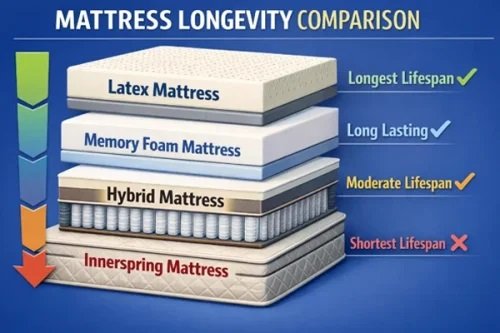
A mattress rarely lives up to its labelled promise on the tag. The support decreases, the surface drops, and your sleep quality degrades. By the time you realise it’s high time to replace the mattress, it is already past its usual lifespan. That’s why you will generally find a mattress lifespan quoted as a range – it is barely a single number.
The life expectancy of a mattress is usually described in good conditions; ‘guarantee’ is not a word that is commonly used. Where a used mattress lands within the range is determined by a few factors – the base it sits on, how often it is turned, and how it is handled during moves.
Owning a mattress can be expensive for people who frequently move. However, renting changes this. An individual choosing to get a mattress on rent from Rentomojo covers free maintenance and relocation, so two things that often cut a mattress short are aligned with the service that originally owns it.
What is the Average Lifespan of a Mattress?
It is widely known that the average life expectancy of a mattress is 7-10 years.
| Mattress type | Commonly quoted lifespan | Shows wear first |
| Innerspring | 5–7 years | Coil tension, then edge support |
| Memory foam/ hybrid | 7–10 years | Foam recovery under the hips |
| Natural latex | 12–15 years or more | The cover |
What mainly degrades is support, not the surface. The layer underneath eventually stops pushing back, so the spine does not hold in line. That’s why the mattress might look new, but its condition has gone downhill.
Mattress Warranty vs Mattress Lifespan
In most cases, a mattress warranty is not an estimate of how long it will last. Warranties cover sagging past a certain depth – it is measured with the bed empty. If you notice regular softening, it is not a defect.
It is also easy to void the warranty. Some exclusions are mattress stains, loss of warranty card, and use of an unapproved base. Only the original invoice and a protector can best shield a claim.
What Shortens the Lifespan of a Mattress
Most mattresses lose several years of life to how you handle them. The manufacturing problems come later.
1. Why a New Mattress Sags Early
The base does half the work. Wide gaps between slats let foam settle into them, so dips set in the shape of the frame. An old cot that already sags passes its shape upward within months. Lift the mattress off and look at the frame alone. If the dip follows the slats or the centre rail, the base is at fault. And a new mattress will do the same.
2. How often to rotate a Mattress
Rotation matters because most people sleep in the same spot every night. So, one part of the mattress bears the load while the other parts usually remain empty. Turning the mattress end to end every six months spreads that load. Most mattresses are single-sided, so it’s better to rotate than flip. The first year matters most, since foam settles fastest when new.
3. Why Folding Damages Foam and Springs
A house move can do more harm in one afternoon than a year of sleep. Foam creases when folded, and the crease often remains. Spring units bend at the border rod and never sit flat again. For anyone who moves every couple of years, each move causes a little wear and tear.
4. How Cleaning Breaks Foam Down
Cleaning with water is a common mistake, as it often leads to over-wetting. Soaking a stain pushes moisture into the core, where it never dries, and the smell that follows is the sign it is still there. Blot rather than rub, use as little liquid as possible, and dry with a fan.
5. How You Are Using the Bed Matters
Small daily habits do quiet damage. Sitting on the same edge to put on shoes breaks down the border long before the middle wears out. Children jumping put far more force through one point than a sleeper does, and couples who never swap sides age the halves unevenly.
When Should You Change a Mattress?
The main signs are physical. If you think you bought a mattress 3 years ago and are already seeing physical signs of wear, you may want to consider replacing it.
- A dip or body impression still visible after the bed is stripped.
- Waking with a sore back that eases within an hour of getting up.
- Sleeping better away from home than in your own bed.
- A spring unit that creaks under ordinary movement.
- A smell that returns after cleaning.
Renting or Buying a Mattress if You Frequently Move
Mattress lifespan is not just about comfort level. It’s also about cost. A mattress that lasts 10 years costs half as much per year as the same one that is replaced after 5 years of use.
Buying a mattress means its upkeep and replacement are on you. Renting a mattress means the service provider replaces the mattress when it’s beyond repair. Platforms like Rentomojo offer mattresses with a minimum 3-month tenure, including repairs and maintenance.
Which option suits you best depends on your living situation. Buying makes sense for a settled home with a good base. On the other hand, renting is ideal for short stays and people frequently shifting within cities.
Final Thoughts
A sagging base, lack of rotation, and mattress folding can worsen the quality. The mattress lifespan often varies with its base, careful handling, and dry cleaning. If you ignore these habits, the mattress that’s supposed to last 10 years may wear out in 5. So, keep an eye out for the signs instead of when you bought the mattress.
